Same Short Stem, Different Fixation: Why Positioning Matters in Hip Replacement
Short-stem hip replacement is designed to preserve bone and respect the individual anatomy of the proximal femur. However, choosing a short stem does not mean that the implant should be positioned in exactly the same way in every patient.
A study published in September 2026 provides further evidence that the anatomy of the femur can substantially influence the final position and fixation pattern of a calcar-guided short stem. Even when metaphyseal-dominant fixation was planned before surgery, the postoperative fixation pattern did not always correspond to that plan.
This distinction matters. Stem position can affect primary stability, femoral offset, leg length and the overall biomechanics of the reconstructed hip.
What is a calcar-guided short stem?
A calcar-guided short stem is a bone-preserving femoral implant used in total hip arthroplasty. Its insertion follows the medial femoral neck and the calcar femorale—the dense region of bone that transfers load from the hip joint into the femur.
Compared with many conventional stems, calcar-guided short stems preserve more of the femoral neck and proximal bone. Their curved design also allows a degree of positional variability.
This variability can be beneficial because it enables the surgeon to adapt the implant to the patient’s anatomy. It also means, however, that the same stem may achieve different patterns of fixation in different hips.
Metaphyseal- and diaphyseal-dominant fixation
In metaphyseal-dominant fixation, the stem is primarily supported by the proximal part of the femur, close to the hip joint. This is often considered one of the principal objectives of contemporary short-stem arthroplasty.
In a more diaphyseal-dominant fixation pattern, the implant engages the femur further distally. This does not necessarily represent an incorrect result. Depending on the patient’s anatomy, bone quality and reconstructive requirements, different fixation strategies may be appropriate.
The important point is that the fixation pattern should be understood and, whenever possible, anticipated before surgery.
What did the new study show?
Sonoda and colleagues analysed 62 consecutive total hip arthroplasties performed with a calcar-guided short stem. All cases underwent preoperative CT-based three-dimensional planning intended to achieve metaphyseal-dominant fixation.
After surgery:
- 43 hips showed metaphyseal-dominant fixation;
- 19 hips showed diaphyseal-dominant fixation.
A lower planned stem position and a larger femoral neck-shaft angle were independently associated with a change towards diaphyseal-dominant fixation.
The authors identified proposed threshold values of −4.4 mm for their planned stem-height parameter and 134.5 degrees for the neck-shaft angle. They concluded that surgeons should consider a planned diaphyseal-dominant strategy or an alternative implant design when these anatomical features are present.
The study is relatively small and reflects a specific implant and planning method. It does not establish whether one fixation pattern produces better long-term clinical results. Nevertheless, it demonstrates an important principle: the actual fixation of a calcar-guided short stem cannot be predicted from the implant name alone.
Why does stem position matter?
The position and fixation of a short stem may influence several essential objectives of hip replacement:
- primary implant stability;
- reconstruction of leg length;
- restoration of femoral offset;
- tension and function of the hip muscles;
- load transfer within the proximal femur;
- preservation of bone for possible future surgery.
A short stem should therefore not be assessed only by its size or design. Its three-dimensional relationship with the femoral neck, calcar, lateral cortex and medullary canal is equally important.
Modern short-stem hip arthroplasty requires more than simply inserting a smaller implant. It requires an individual fixation strategy.
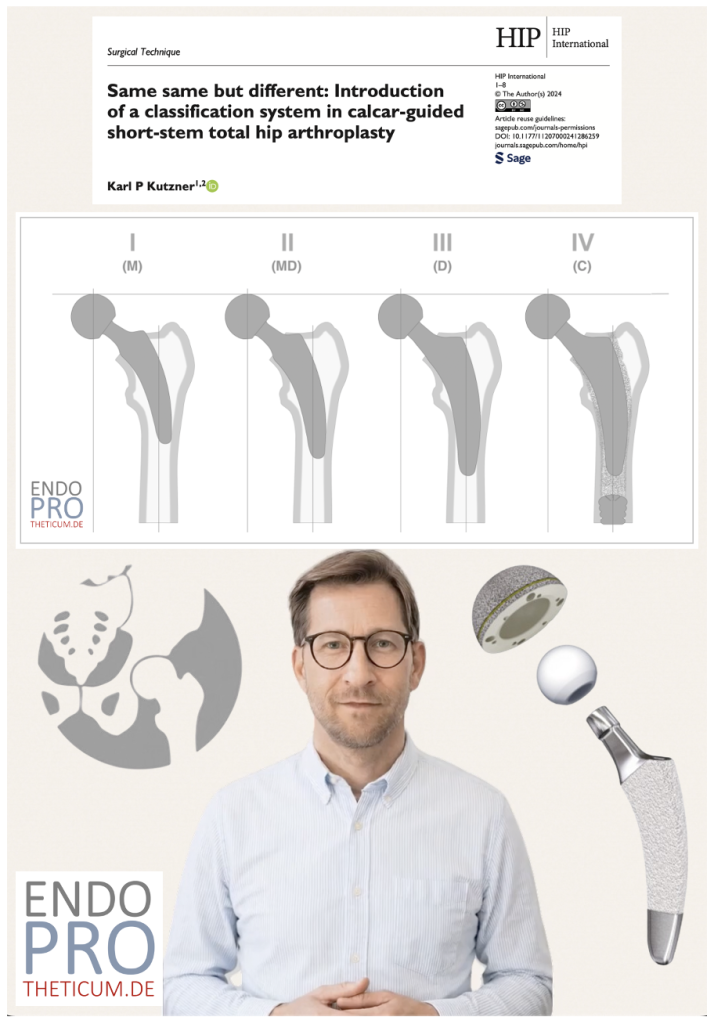
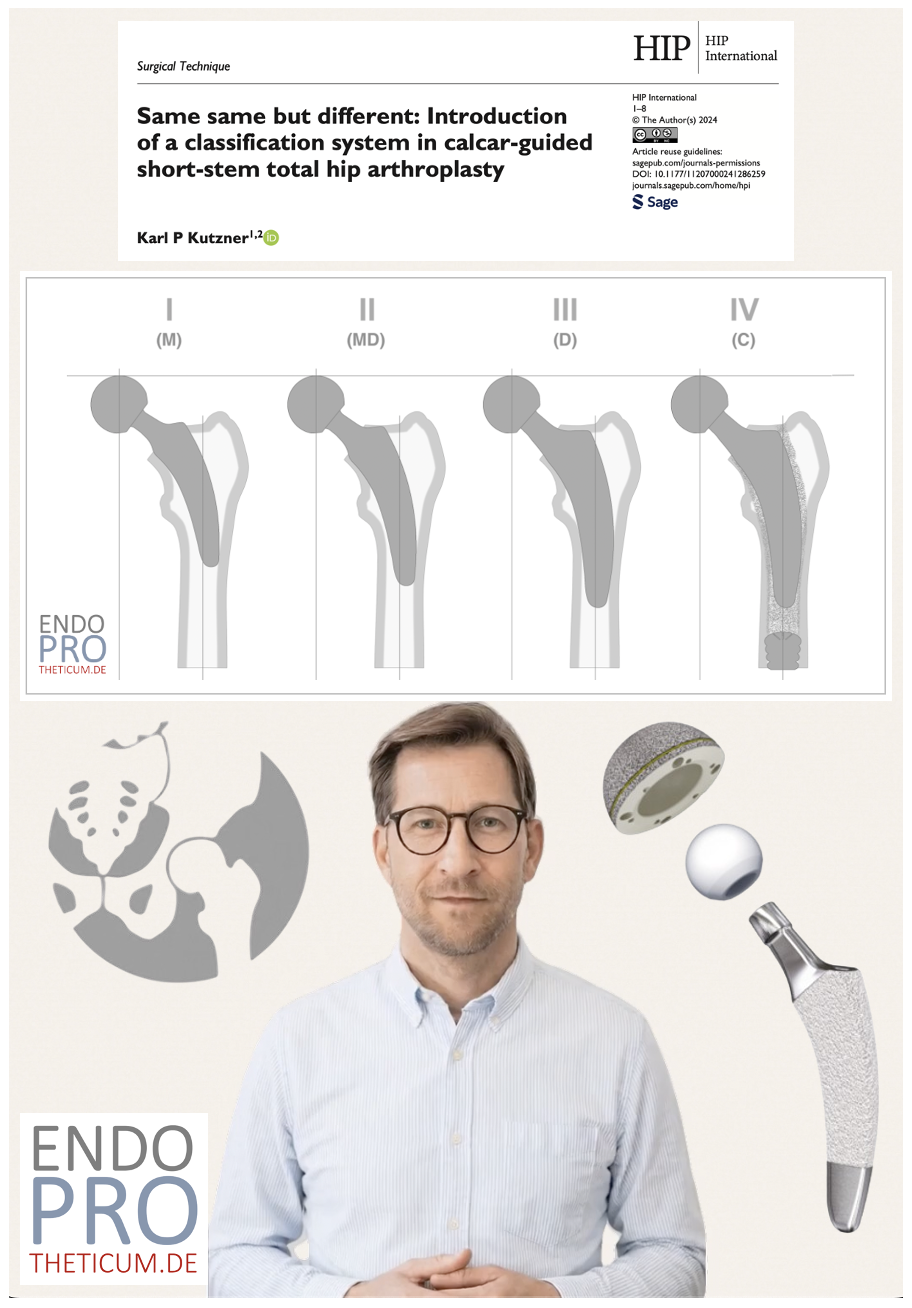
The Kutzner Classification
The scientifically published Kutzner Classification was developed to describe the different positioning and fixation strategies that can be achieved with calcar-guided short stems.
It distinguishes four characteristic groups:
- Group I: pronounced valgus positioning;
- Group II: moderate valgus positioning;
- Group III: neutral or anatomical positioning;
- Group IV: varus positioning with increased lateral cortical contact.
The classification is not intended merely to describe different appearances on postoperative X-rays. It provides a common terminology for understanding how the same short-stem design can be positioned differently according to the anatomy of the proximal femur and the intended reconstruction.
The study by Sonoda and colleagues did not investigate or validate the Kutzner Classification directly. It used a different categorisation based on metaphyseal- or diaphyseal-dominant fixation.
However, its findings independently support the broader concept underlying the Kutzner Classification: a calcar-guided short stem does not produce one uniform fixation pattern. Anatomy, stem depth and surgical positioning interact to determine the final result.
Is metaphyseal fixation always preferable?
Not necessarily.
Metaphyseal fixation is an important objective of many short-stem designs. Nevertheless, the optimal strategy depends on factors such as:
- the shape and width of the proximal femur;
- the femoral neck-shaft angle;
- bone quality;
- femoral offset;
- the level of the femoral-neck osteotomy;
- the required correction of leg length;
- previous deformity or surgery.
A single standard position cannot adequately represent the anatomical diversity encountered in hip replacement surgery.
In some patients, a more distal fixation pattern may be appropriate or unavoidable. In others, the surgeon may decide that an alternative stem design offers a more predictable reconstruction.
The relevant question is therefore not simply, “Which short stem is being used?” It is also, “Which positioning and fixation strategy is planned for this particular hip?”
What does this mean for patients?
For patients considering a short-stem hip replacement, the findings underline the importance of individual planning and surgeon experience.
The potential benefits of a short stem do not result from the implant alone. They depend on the combination of:
- appropriate patient selection;
- detailed analysis of the individual anatomy;
- selection of a suitable implant;
- precise surgical technique;
- correct restoration of hip biomechanics.
An experienced short-stem surgeon should be familiar not only with the implant but also with the different ways in which it can be positioned and fixed.
Short-stem hip replacement is therefore not a standardised, one-position-fits-all procedure. Its central principle is the adaptation of the implant and fixation strategy to the individual patient.
Frequently asked questions
What is the main advantage of a short-stem hip replacement?
Short stems are designed to preserve more proximal femoral bone and facilitate an anatomy-adapted reconstruction. Whether an individual patient is suitable depends on anatomy, bone quality and other clinical factors.
Can the same short stem be positioned differently?
Yes. The same calcar-guided implant can achieve different positions and fixation patterns depending on the anatomy of the femur, the osteotomy level and the surgical strategy.
Is a short-stem hip replacement suitable for every patient?
Short stems can be used in many patients, including selected younger and active patients. Poor bone quality, major deformity, previous surgery and certain anatomical conditions may require a different implant.
What does the Kutzner Classification describe?
The Kutzner Classification describes four characteristic positioning and fixation strategies for calcar-guided short stems. It helps surgeons and researchers analyse how the same implant can interact differently with the proximal femur.
Does a more distal fixation pattern mean that the operation has failed?
No. A more distal or diaphyseal-dominant fixation pattern is not automatically a failure. Its significance depends on implant stability, reconstruction of hip biomechanics and the clinical course. It should, however, be recognised and considered during preoperative planning.
About Prof. Dr. Karl Philipp Kutzner
Prof. Dr. med. Karl Philipp Kutzner is an orthopaedic surgeon specialising in hip and knee arthroplasty and the founder and Medical Director of ENDOPROTHETICUM Rhein-Main in Germany. His clinical and scientific work focuses particularly on minimally invasive hip replacement, calcar-guided short stems and anatomy-adapted femoral reconstruction.
He developed the Kutzner Classification to provide a structured scientific framework for the different fixation strategies of calcar-guided short stems.
MORE INFORMATION ABOUT THE ENDOPROTHETICUM HERE:
Scientific references
Sonoda K, Kubo Y, Hara T. Preoperative factors associated with alignment change from planned metaphyseal- to diaphyseal-dominant fixation in calcar-guided short-stem total hip arthroplasty. International Orthopaedics. Published online September 18, 2026. doi: 10.1007/s00264-026-07039-z.
Kutzner KP, et al. Classification of calcar-guided short-stem total hip arthroplasty: the Kutzner Classification. Hip International. doi: 10.1177/11207000241286259.
Specialist assessment for international patients
Patients considering short-stem hip replacement in Germany can request an individual assessment from ENDOPROTHETICUM Rhein-Main. Available X-rays, medical reports and information about current symptoms can be reviewed before planning an appointment or treatment in Germany.
Request an international hip assessment